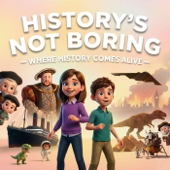
Maths for Kids / Maths is Not Boring: The Kids Maths Podcast artwork

Kids & Family · Kidopoly

Maths for Kids / Maths is Not Boring: The Kids Maths Podcast

by Kidopoly

A groundbreaking podcast for curious kids aged 4-12 that proves maths is anything but dull.Join our fictional AI hosts Mira, a brilliant 9-year-old, and her younger brother Finn, age 7, as they set off on a journey into one great mathematical idea each episode. From numbers that never end and shapes with only one side to the strange rules of chance and the secret patterns in a snowflake, each episode uncovers an idea that is simple at its heart and extraordinary because it is everywhere - told in a way that actually makes sense to kids.Nobody does sums here. Whether you're discovering why infinity comes in different sizes, how a shuffled pack of cards is almost certainly in an order no one has ever seen, why honeycombs are made of hexagons, where the number zero came from, or what makes a prime number special - Maths is Not Boring turns big ideas into stories that ignite curiosity and wonder, and gives kids one more clue to how the world works.Because maths isn't a list of rules to learn. It's the most beautiful way anyone has ever found of seeing the world. A note on why we use AI. For us, AI allows us to deliver learning at a scale and quality that previously would have been too expensive. If we make the odd technical error, or the sound goes a bit funny, bear with us, we’re trying our best. We hope you enjoy the show!


Latest episodes

Showing 20 · updated from the feed

What is the Collatz conjecture?

Have you ever heard of a math puzzle that acts like a wild weather storm? In 1937, a mathematician named Lothar Collatz invented a simple number machine with just two rul

Oct 10
9 min

What is Zeno's paradox?

Have you ever tried to walk across a room, but realized you have to go halfway first? And then half of that remaining distance? And half of that? Welcome to one of the mo

Oct 9
12 min

What was the first times table?

Have you ever wondered who invented times tables? Or why three times four is exactly the same as four times three? It's time to discover the quiet magic of multiplic

Oct 8
11 min

Platonic Solids for Kids: Why There Are Only Five Perfect Dice

The story of the Platonic solids for kids: the five perfect shapes studied by Theaetetus and Plato in ancient Athens, and how Euclid proved around 300 BCE there can never

Oct 7
9 min

Averages for Kids: Why No One Is Average in Every Way

The story of averages for kids: how around 1950 Gilbert Daniels measured 4,063 United States Air Force pilots and found that not one was average in every way. • Why cock

Oct 6
10 min

Binary for Kids: How Computers Count With Only 1s and 0s

The story of binary for kids: how Gottfried Wilhelm Leibniz wrote out a way of counting with only 0 and 1 in 1679, long before computers. • How to count one, two, three

Oct 5
11 min

Triangles for Kids: Why the Strongest Shape Has Three Sides

The story of triangles for kids: why a triangle will not squash flat when a square does, and how Gustave Eiffel built his tower in Paris from triangles in 1889. • What e

Oct 4
11 min

Googol for Kids: What a Googol Is and Who Named It

The story of the googol for kids: how nine-year-old Milton Sirotta named the number one followed by a hundred zeros for his uncle, mathematician Edward Kasner, around 192

Oct 3
13 min

Fractions for Kids: How the Ancient Egyptians Shared Bread

The story of fractions for kids: how the Egyptian scribe Ahmes wrote down problems about sharing loaves of bread fairly about 3,500 years ago, in the scroll now called th

Oct 2
13 min

Tessellation for Kids: How Tiles Cover a Floor With No Gaps

The story of tessellation for kids: shapes that cover a floor with no gaps, and how David Smith from Bridlington in Yorkshire found a tile in 2022 whose pattern never rep

Oct 1
12 min

The Equals Sign for Kids: Who Invented It and What It Means

The story of the equals sign for kids: how Welsh doctor Robert Recorde drew two parallel lines in his 1557 book The Whetstone of Witte. • Why Recorde chose two lines of

Sep 30
9 min

The Law of Large Numbers for Kids: Why Coin Tosses Even Out

The story of the law of large numbers for kids: how John Kerrich tossed a coin 10,000 times during the Second World War, and how Jacob Bernoulli explained the result in a

Sep 29
11 min

Negative Numbers for Kids: How Numbers Go Below Zero

The story of negative numbers for kids: numbers below zero, from Chinese counting rods about 2,000 years ago to Brahmagupta's rules in India in 628 CE. • How Chines

Sep 28
9 min

Fractals for Kids: Why the Coastline of Britain Never Ends

The story of fractals for kids: why the coast of Britain gets longer the shorter your ruler, and how Benoit Mandelbrot asked the coastline question in 1967. • How Lewis

Sep 27
9 min

Place Value for Kids: Why We Count in Tens

The story of place value for kids: why ten fingers mean most of the world counts in tens, and how the system we use today grew up in India. • How the Babylonians counted

Sep 26
11 min

The Fourth Dimension for Kids: How to Picture a 4D Shape

The story of Flatland and the fourth dimension for kids: Edwin Abbott Abbott's 1884 book about a square who lives in a flat world and meets a sphere. • What a spher

Sep 25
10 min

The Pigeonhole Principle for Kids: Why Two Pigeons Must Share

The story of the pigeonhole principle for kids: why two people in London must have the same number of hairs on their heads, and how Peter Dirichlet set out the rule in 18

Sep 24
12 min

The Monty Hall Problem for Kids: Why Switching Doors Wins

The story of the Monty Hall problem for kids: three doors, one car and two goats, and how Marilyn vos Savant explained in 1990 why switching wins twice as often. • Why y

Sep 23
13 min

The Four Colour Theorem for Kids: Why Maps Need Four Colours

The story of the Four Colour Theorem for kids: how student Francis Guthrie noticed in 1852 that four colours are enough for any map, and how it took until 1976 to prove i

Sep 22
12 min

The Seven Bridges of Königsberg for Kids: How Euler Solved It

The story of the seven bridges of Königsberg for kids: the Sunday walk nobody could finish, and how Leonhard Euler showed why in 1735 by drawing the first network. • How

Sep 21
11 min

Chart trend

Position in the Kids & Family chart (US), last 90 days.

#95
all-time peak
4
days in the top 100 since Sep 2026

Chart positions

Where Maths for Kids / Maths is Not Boring: The Kids Maths Podcast ranks today in each Apple Podcasts chart (US, Oct 10, 2026).

#200 ▼ 8 Kids & Family US

More podcasts like Maths for Kids / Maths is Not Boring: The Kids Maths Podcast

Popular shows in Kids & Family, for your next listen.

Browse charts by category

Daily updated Apple Podcasts rankings for the United States.

About Maths for Kids / Maths is Not Boring: The Kids Maths Podcast on Reason.fm

Here you find the Apple Podcasts chart positions of Maths for Kids / Maths is Not Boring: The Kids Maths Podcast, its latest episodes to listen to directly, and reviews from listeners. Rankings are updated daily for the United States.

Contact

Questions or issues? Reach us at hello@reason.fm

0:000:00