
Most podcasts that last are built on cost control at least as much as on audience size. Downloads help, sure. Cash flow keeps the lights on.
Key Takeaways
- Podcast Index lists more than 4 million podcasts, but only around 450,000 published an episode in a recent 90-day window, and only a small minority of those earn a full-time living.
- On Buzzsprout, the median episode gets around 30 downloads in its first seven days, so most shows need revenue models beyond ads alone.
- Published rate cards put a 60-second host-read spot at roughly $25 per thousand downloads; programmatic inventory usually sells for less, and the gap reflects a trust premium.
The numbers tell a sobering story. Podcast Index counted roughly 4.3 million podcasts in late 2024, of which only about 450,000 had published a new episode in the previous 90 days. Industry analysts generally agree that a minority of active shows generate meaningful revenue, and a much smaller group earns enough to be someone's full-time living. That is the gap between starting a show and running a business.
If you've listened closely over the last few years, you've heard the shift. Hosts talk more like operators and less like artists. Ad slots tighten. Release schedules lock in. Bonus feeds appear. Call it survival, since the economics leave little room for anything else.
Paying listeners behave differently too. Someone who pays for a premium feed tends to show up for every episode and skips less, and that change in behavior is exactly what the business side of a podcast is trying to buy.
Podcasts run on unit economics
A podcast episode feels weightless when you tap "play." Behind it, there's friction everywhere: editing hours, hosting fees, guest booking, legal review, marketing and time.
Consider a weekly interview show with decent production. Once you count labor, it can easily cost $300 to $800 per episode, before any studio fantasies. At 52 episodes a year, that is roughly $15,000 to $40,000 before profit. Higher-end productions with dedicated producers, sound engineers and post-production can climb to $2,000 to $5,000 per episode or more.
Typical podcast production costs per episode (2025 estimates)
| Production tier | Setup | Cost per episode | Annual (weekly) |
|---|---|---|---|
| Solo / DIY | Basic mic, free editing, self-hosted | $50 to $150 | $2,600 to $7,800 |
| Mid-range | Freelance editor, decent gear, hosting plan | $300 to $800 | $15,600 to $41,600 |
| Professional | Producer, sound engineer, studio, marketing | $2,000 to $5,000 | $104,000 to $260,000 |
| Network / premium | Full team, original scoring, research staff | $10,000 to $25,000+ | $520,000 to $1.3M+ |
Source: rough industry estimates for U.S. productions; real costs vary widely by market and format.
That's why CPM math matters. CPM (cost per mille) is the price an advertiser pays per 1,000 downloads. Rate cards published by marketplaces such as AdvertiseCast have put the average at around $18 for a 30-second spot and $25 for a 60-second spot, with premium host-read slots on niche shows often priced higher. At $25 CPM, 20,000 downloads bring in $500 per ad slot. Run two slots and you gross $1,000 an episode. Suddenly the show works, barely, and two missed weeks hurt.
The limits of "just grow the audience"
A popular belief holds that podcasts scale like social feeds. They behave very differently. Attention is finite and listening time even more so. Edison Research's Infinite Dial 2024 found that 47% of Americans 12+ listen to podcasts monthly (roughly 135 million people), and most of them already follow several shows. Their listening hours are spoken for.
Look at Acquired, the long-form company histories from Ben Gilbert and David Rosenthal. For years the show ran lean: long episodes, two hosts, minimal production overhead. When sponsorships arrived, the margins made sense because the cost base had stayed small.
Or take My First Million, hosted by Sam Parr and Shaan Puri. It built audience trust early and used it as the top of a funnel for other businesses. When HubSpot bought Parr's company The Hustle in 2021, the podcast came with it and became part of HubSpot's media arm.
Audience growth helps. Business design decides outcomes.
Revenue potential by audience size (per episode, estimated)
| Downloads per episode | Audience tier | Ad revenue per episode (2 slots) | Realistic revenue mix |
|---|---|---|---|
| Under 1,000 | Hobby / early stage | $0 to $50 | Mostly unpaid; affiliate links, listener donations |
| 1,000 to 5,000 | Emerging | $50 to $250 | Niche sponsors, Patreon, small product sales |
| 5,000 to 20,000 | Mid-tier | $250 to $1,000 | Reliable sponsorships, memberships, live events |
| 20,000 to 100,000 | Established | $1,000 to $5,000 | Premium sponsors, courses, consulting, licensing |
| 100,000+ | Top tier | $5,000 to $50,000+ | Multi-sponsor deals, equity, media company model |
Source: estimates based on standard CPM rates.
For context, Buzzsprout's platform stats, updated monthly, have put the median episode at around 30 downloads in its first seven days. An episode needs roughly 400 or more first-week downloads to reach the top 10% of Buzzsprout shows, and about 1,000 or more for the top 5%. The numbers are humbling, and they explain why most shows need business models beyond advertising alone.
Podcasts behave like restaurants
Think about a neighborhood restaurant. Rent stays fixed. Ingredients fluctuate. Bad weeks hurt fast, and good weeks don't last forever.
Podcasts work the same way. Hosting fees are your rent. Editing is payroll. Ads are table turns. Patreon is the regulars who tip even in weeks they don't come in.
When The Daily moved its back catalog behind the New York Times audio subscription in 2024, leaving only the most recent episodes free on Apple and Spotify, the Times was smoothing revenue. The show still reaches a huge free audience, but its archive now sells subscriptions. Predictable income beats spikes.
Recurring revenue lowers stress, improves planning and changes editorial decisions. Shows that have it can stop chasing clicks and start serving listeners.

Frameworks podcasters use without naming them
Many podcasters operate with business logic even if they rarely describe it that way. Behind the scenes, the same frameworks used in startups and media companies shape decisions about growth, content and monetization.
One example is lifetime value versus acquisition cost. Creators may not label it that way, but the question comes up naturally: what is a listener worth over time, and how much effort or marketing did it take to attract that person? A listener who stays subscribed for years, hears dozens of episodes and eventually buys a product or supports the show is worth far more than someone who listens once and disappears.
Another common pattern is the 80/20 principle. In many podcasts, a relatively small share of episodes generates most of the impact. Certain interviews, topics or series resonate more strongly and drive the majority of downloads, shares or revenue. Over time, creators learn which themes produce that response and shape future episodes around them.
Podcasters also borrow heavily from behavioral economics. Limited offers create urgency, clear pricing anchors make decisions easier, and regular publishing schedules reinforce listening habits. A weekly release becomes part of a routine, and listeners start to expect a new episode at a familiar moment in their week.
Habit research supports that instinct: consistency and predictability help behaviors stick. When a show appears in the same feed on the same day each week, it becomes easier to fold into daily life. That reliability benefits audiences, and it also matters to advertisers, who prefer formats where attention shows up regularly and predictably.
Rethinking the "bigger is better" assumption
In podcasting, growth is often treated as the main goal. More downloads, wider reach and larger audiences are seen as signs of success, yet scale and strong economics often part ways. U.S. podcast ad revenue reached about $2.43 billion in 2024 and $2.86 billion in 2025, according to the IAB/PwC Internet Advertising Revenue Report. That's real money, but it is concentrated: the large networks and the biggest shows take most of it, leaving the long tail to find other revenue paths.
$2.86 Billion in U.S. Podcast Ad Revenue in 2025
Up 17.6% from about $2.43 billion in 2024 (IAB/PwC Internet Advertising Revenue Report)
A focused show with a smaller audience can generate meaningful revenue if its listeners share a clear interest and trust the host's recommendations. In those cases, selling a simple product, membership or service can be more reliable than depending on advertising alone.
Large audiences also bring new pressures. Production costs rise, expectations grow, and monetization often depends on steady ad demand. That model can work, and it is one path among several. Many podcasts perform better as focused media businesses built around a defined community, where relevance, loyalty and a smaller but highly engaged audience produce sustainable revenue.
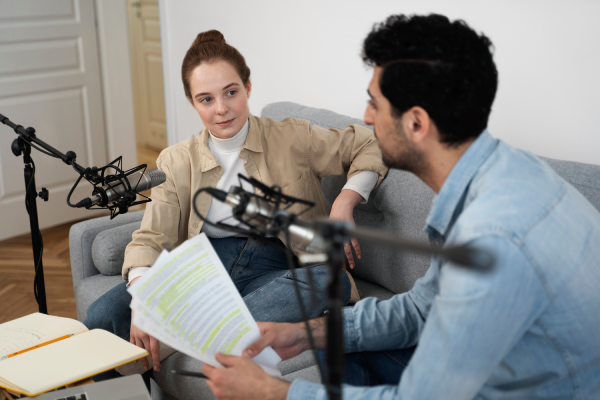
Shifts shaping podcast economics in 2026
Several changes in the last few years show how podcast economics are evolving.
First, brand budgets have moved back toward host-read ads. Advertisers value the credibility of a trusted voice recommending a product in the middle of a conversation. Programmatic placements lack that relationship between host and audience. The trust usually translates into higher recall and stronger conversion, which is why many sponsors still prefer the format even as automated ad marketplaces grow.
About $25 CPM for a 60-Second Spot
Average on published AdvertiseCast rate cards; programmatic inventory usually sells for less
Second, the push toward video podcasts raised production costs for many creators without guaranteeing proportional revenue. Cameras, lighting, editing and studio upgrades add complexity and expense, and adding video to an audio show can raise per-episode costs substantially, depending on quality expectations. Video can expand reach on platforms like YouTube, but the extra audience does not always bring higher advertising income. For many shows, the economics of video remain uncertain unless the audience is already large.
At the same time, listener-supported models have become an important stabilizer. Memberships, paid feeds and direct support can provide predictable income when advertising markets slow down. Subscriptions may grow slowly, but they often create a sturdier foundation than fluctuating ad budgets. Even successful shows usually convert only a small slice of their free audience into paying members, which is why the price and the perks of a membership need careful design.
It is no coincidence that platforms such as Spotify and Apple keep investing in subscription tools for creators. Platforms rarely promote a feature without a clear economic reason, and when audience payments increase, creators and platforms share the revenue.
If you are planning a show, or judging whether one you love can survive, the practical checklist is short: know the real cost of an episode, estimate revenue from your actual downloads at realistic CPMs, add at least one source of income that listeners pay directly, and treat the podcast as a small business with a format that can last for years.