
Key takeaway: Audio tools (community radio, podcasts, voice menus on basic phones and voice assistants) lower the literacy, language and access barriers that kept about 1.4 billion adults outside the formal financial system in 2021. Traditional finance asks people to read, type and already understand the rules; audio reaches them through a voice they can trust.
What if financial access started with a voice instead of a bank branch? No form, no password, no long instruction manual: just a simple audio message. The shift sounds small, and it is changing how millions of people connect with money, services and opportunity.
Financial inclusion has always had a barrier problem. Too much paperwork, too much jargon, too many systems built for people who already understand the system. Audio cuts through that noise (ironically, by adding sound). It reaches people where they are, in a format that feels natural, familiar and human.
The scale of the gap is large. The World Bank's Global Findex 2021 counted roughly 1.4 billion adults without an account at a bank, another financial institution or a mobile money provider. The Global Findex 2025 report, based on 2024 surveys, puts the number at about 1.3 billion, with 79% of adults now holding an account.
Where audio works and paperwork fails
Most financial systems were designed for a particular kind of customer. They assume literacy, stable internet and prior knowledge, which is like handing someone a detailed map when they've never used a compass.
Audio flips that dynamic. It speaks instead of showing and explains instead of assuming. Above all, it removes the intimidation that often comes with financial tools.
Reading a financial document can feel like decoding a foreign language; hearing someone explain it feels like a conversation over coffee. The first creates distance and the second builds trust. The same intimacy, which text and video struggle to match, explains why podcast ads feel more trustworthy than other formats.
Audio taps into something deeply human: our instinct to listen to stories and make sense of them. That matters when you're teaching saving, budgeting or digital payments.
The financial inclusion gap: who gets left behind
| Barrier | Population affected | How audio helps |
|---|---|---|
| Low literacy | About 739 million youth and adults lacked basic literacy skills in 2024 (UNESCO) | Voice instructions require no reading |
| No internet access | 2.6 billion people offline in 2023 (ITU) | Voice menus and radio work on basic phones without data |
| Language exclusion | About 40% of people lack education in a language they speak or understand (UNESCO) | Audio localizes easily into dialects and native languages |
| Gender gap in finance | About 740 million of the 1.4 billion unbanked adults were women (Findex 2021) | Mobile audio tools reach women who rarely visit a branch |
Sources: World Bank Global Findex 2021 | UNESCO Institute for Statistics | ITU Facts and Figures 2023
Voice-based money tools
Around the world, voice technology is turning from a convenience into a bridge. From interactive voice response (IVR) menus to WhatsApp voice notes, people manage money without typing a word.
In regions with low literacy, this matters a great deal. Users can check balances, hear payment confirmations or learn about loans through spoken instructions, with no reading required.
Audio also skips the need for a high-end smartphone or fast internet. A basic mobile phone is enough, which makes voice one of the most scalable tools in financial inclusion. It rides on the mobile money boom: GSMA's State of the Industry Report on Mobile Money 2024 counted 1.75 billion registered mobile money accounts at the end of 2023, and the 2025 edition reported more than 2 billion. The payoff can be real. In Kenya, economists Tavneet Suri and William Jack estimated that access to the M-Pesa mobile money service lifted about 2% of Kenyan households (roughly 194,000) out of poverty, with the strongest effects among households headed by women.
Podcasts as financial teachers
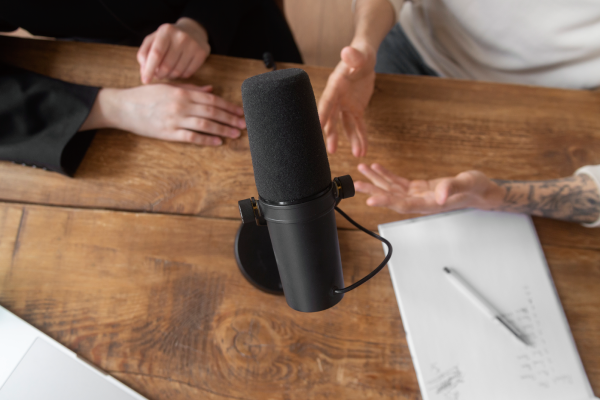
Podcasts have grown into classrooms you can carry in your pocket, and for financial literacy that's a big deal. As we explored in how podcasts are filling education gaps, audio learning reaches audiences that traditional institutions miss.
Imagine learning to manage debt during your commute, or getting a handle on investing while you cook dinner. Podcasts turn idle moments into learning time without overwhelming the listener.
They also humanize finance. In place of dry explanations you hear real voices, real stories and real struggles, and that relatability makes hard topics approachable. It's the reason storytelling beats spreadsheets when it comes to financial understanding.
Podcasts do two things especially well:
- They break financial concepts into digestible conversations
- They build trust through consistent, familiar voices
Information plus connection is what drives behavior change. Listeners who hear specific, timely money advice from a host they trust are more likely to act on it, a pattern we explored in how money advice in podcasts turns into action.
Community radio got there first
Before podcasts and smartphones, there was community radio, and it remains one of the most effective tools for financial inclusion in rural and underserved areas.
Community stations speak the local language, understand the local context and talk about everyday money problems. That relevance makes the message stick.
Picture a farmer tuning in to learn about crop insurance, or a shop owner hearing about microloans in a radio segment. These are practical, usable lessons delivered in a familiar voice, and for many listeners that information is the first step toward taking part in the financial system.
Trust comes first
People need to feel safe before they engage with a financial system, and that kind of trust is hard to build through cold interfaces and complex forms. Access on paper means little without it.
A voice changes the equation. It feels personal and accountable. Compare a friendly voice guiding you through a process with a wall of text: the first reassures you, the second overwhelms you. In finance, that reassurance often decides whether someone signs up at all.
Language and literacy barriers
Language is one of the biggest obstacles in financial inclusion, and that covers both different languages and different levels of understanding within one language.
Audio adapts. It can be localized, simplified and tailored to a specific community, and it can use tone, emphasis and storytelling to make meaning clearer than text. For people who can't read or write, audio is essential.
Who does the talking matters as well. The question of who gets to speak about money shapes which communities feel included, because people trust advice more when it comes from someone who sounds like them. In practice, audio lowers language barriers in two ways:
- It delivers information in native languages and dialects
- It simplifies complex ideas through storytelling and tone

Audio channels driving financial inclusion
| Audio channel | Reach | Key advantage | Tech required |
|---|---|---|---|
| Community radio | Hard to count; radio is still the most widely available medium in many low-income regions | Local language, cultural relevance | Basic radio receiver |
| Voice menus (IVR) | Common in mobile money markets, which passed 2 billion registered accounts in 2024 (GSMA) | Works without internet or reading | Any mobile phone |
| Podcasts | Industry estimates put global listeners above 450 million | On-demand, in-depth education | Smartphone with data |
| Voice assistants (AI) | About 4.2 billion devices in use in 2020 (Juniper Research estimate) | Instant, personalized answers | Smart device with internet |
Sources: GSMA State of the Industry Report 2024 | DataReportal Digital 2024 report | Juniper Research via Statista (voice assistant estimates)
AI and voice assistants
Add artificial intelligence and audio becomes interactive. Voice assistants can walk users through financial decisions as they happen. Ask a question, get an answer. Need to send money? Just say so. Want to understand an interest rate? Get a plain explanation on the spot.
It's like carrying a patient financial guide in your pocket, one that never judges, never rushes and needs no appointment. As these systems learn from interactions they can become more personal, which can mean better guidance and more confident users.
The catches
Audio has limits of its own. Privacy is a big one: speaking financial details out loud is risky in shared spaces. Accuracy is another, since a misheard instruction can lead to a costly mistake.
Design matters too. Audio content has to be clear, concise and culturally relevant, or it becomes one more layer of confusion. It's also worth understanding the hidden costs behind free audio content when judging which tools truly serve underserved communities.
These problems are solvable, and with careful design the benefits clearly outweigh them.
Where this is heading
The direction is toward financial access that depends less on literacy, location or technical skill. Audio works alongside traditional financial tools: it fills gaps, reaches people the branches never reached and makes finance feel more like a service than a system. When people understand their money, they can plan and build instead of just getting by.
For anyone working on inclusion, the practical lessons are straightforward. Start with the phones people already own, record in the languages they speak, use voices from the community, and pair every explanation with one clear next step. For listeners, the same applies on a smaller scale: a money podcast in your own language, heard regularly, is one of the cheapest financial education tools available.